

The Greeks gave us a word that still shapes how we think about purpose: telos. At its simplest, it means “end,” “goal,” or “completion.”
It is also the root of the word teleology, which means pertaining to design or purpose.
Note:
Equating teleology with creationism is a historical misreading. In Aristotle’s world, purpose belonged to nature itself, not to an external designer.
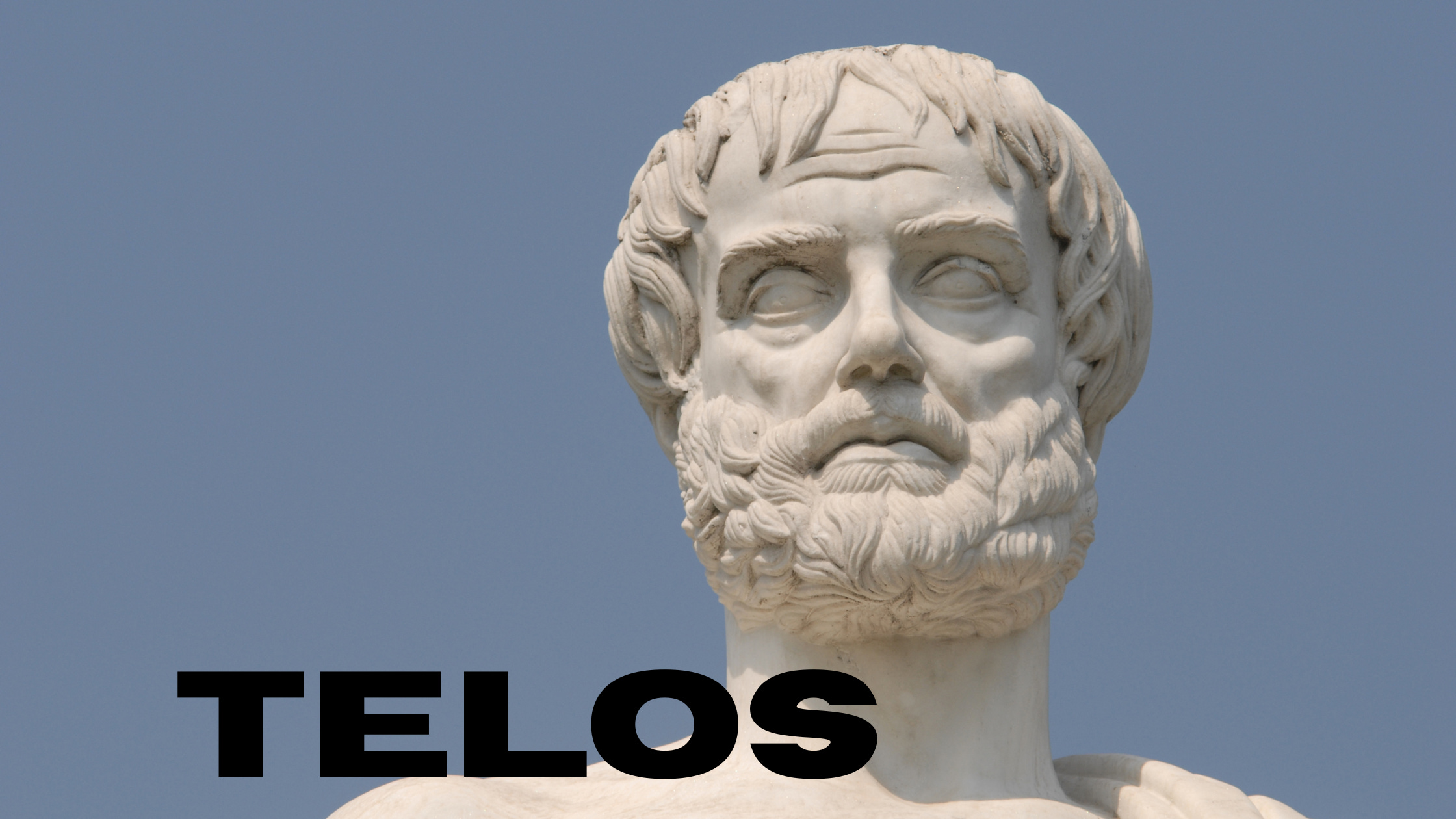
Aristotle used the concept of telos to explain why things exist and how they fulfill their nature. A seed strives toward a tree; a flute finds meaning when played. For him, this wasn’t metaphor. Purpose was built into the fabric of reality.
Today we see things differently. Few of us believe rivers want to reach the sea; we explain the flow by physics. Yet the human hunger for telos hasn’t faded. Writers, creators, entrepreneurs—anyone who makes something new—still wake up asking: what is this for?
Aristotle’s Telos: The Objective End
In Aristotle’s “four causes,” every phenomenon had a final cause (telos), its purpose. Leave that out and you missed the point. For humans, he argued, the telos was eudaimonia—flourishing through reason, virtue, and character over a full life. Money, friendship, or honor may matter, but they are partial. The ultimate end is a life well lived.
The Debate: Objective or Subjective?
Here is where we part ways. The classical view holds that purpose is out there—a tree has an inherent end, a person a natural function. Modern eyes are skeptical. Water doesn’t “seek” the sea; it obeys gravity. The telos is not in the river but in our interpretation of it.
So when we talk about telos today, we aren’t uncovering an objective truth. We’re choosing, creating, or declaring our ends. That subjectivity is its power. To ask about telos is to set intention. It names why the work matters so the details have a direction.
Stoics, Epicureans, and the Human Question
The Greeks themselves weren’t unanimous. The Stoics said the telos of life was to live in harmony with nature, aligned with virtue and reason. Epicureans located it in pleasure, understood as freedom from pain. Skeptics doubted we could know any final end.
What unites these views is the same question we ask today: what is the purpose of life, and by extension, of my work?
Telos for Writers, Creators, and Entrepreneurs
Every project has multiple layers of telos. The essay you’re writing may aim to educate, but also to build trust or spark delight. The company you’re building may aim at profit, but also at creating value or expressing a vision.
When you name the telos, you gain clarity. You cut what distracts and double down on what serves the purpose. And because telos is subjective, you don’t inherit someone else’s definition. You choose.
The Telos Path
As a writer, creator, or entrepreneur, you don’t need to solve philosophy’s oldest debates to walk the Telos Path. You only need to name your purpose before you act. Ask: what is the end here? Clarity? Delight? Connection? Once you name it, the work gains direction. And when the work has direction, so does the path.
Thanks for this explanation. Didn't know this aspect of the Greeks.. this reminds me of when I was in grad school, I went to a school that emphasized quality over quantity. We learned about humanism and the human potential movement, we learned about transpersonal psychology and the mystic paths.. but then there was a class on research. I asked, "how does a school that is so subjective in its teachings have a class on research which is all about the objective truth?" They explained that research to the subjective perspective is all about a qualitative perspective. Most grad schools that have research are specializing in quantitative research. That blew my mind!