

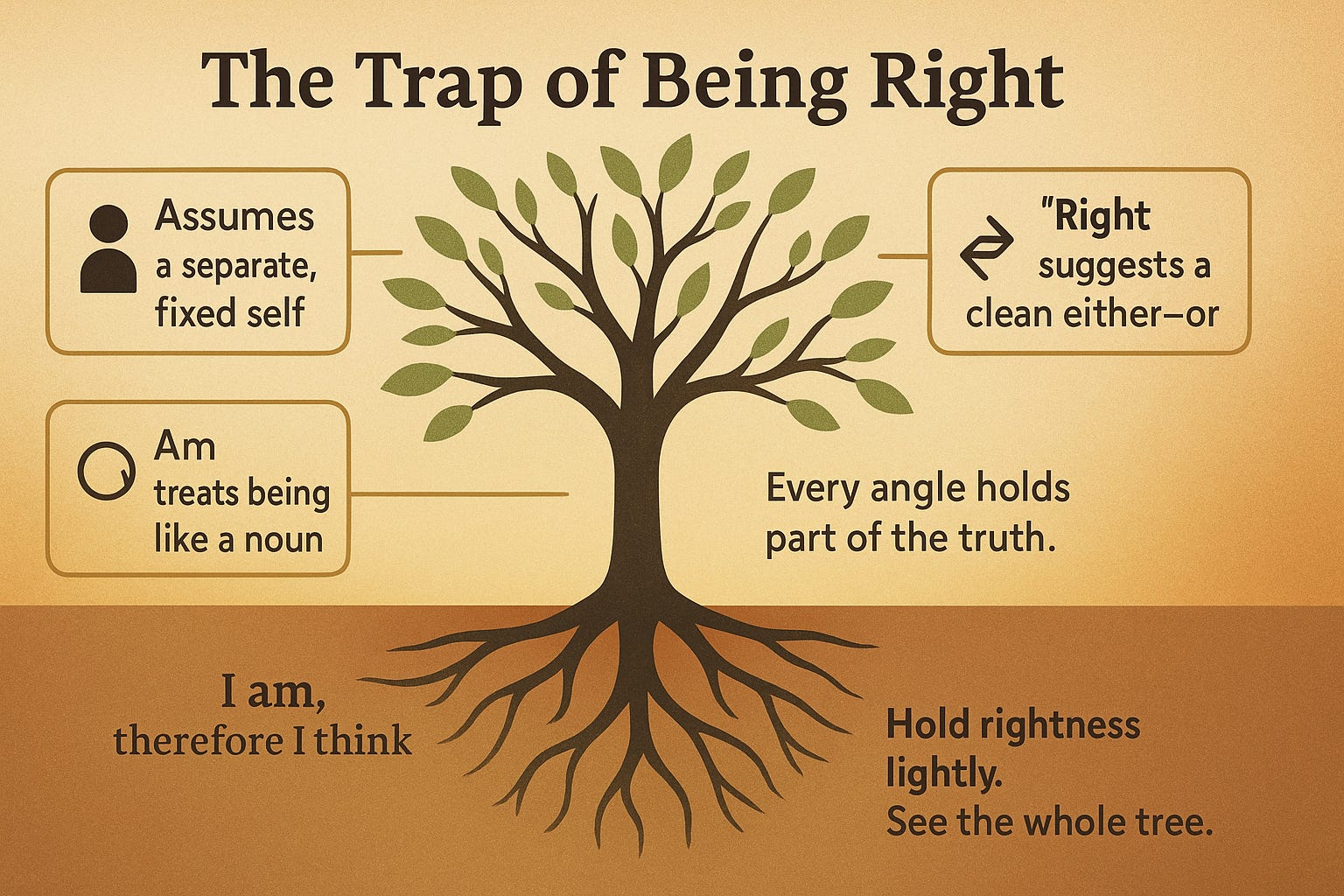
We reach for “I am right” because it feels safe. This essay shows how those three words hide three traps that narrow perception and fuel conflict, and why loosening our grip widens the frame and lowers harm. It matters because most arguments are not about facts alone; they are about identity, language, and emotion braided together.
Three words, three traps
“I” assumes a separate, fixed self. “Am” treats being like a noun rather than a verb. “Right” suggests a clean either–or. Stack them and you get a sentence that hardens views before you even start talking.
I am, then I think
Descartes said, “I think, therefore I am.” Reverse it and the point clarifies: I am, therefore I can think. Being comes first. It reaches beyond the small ego self. When we forget that shared ground, we fight over fragments as if each piece were the whole.
The lens problem
Claiming rightness creates a false binary. The world does not offer only one correct angle. The same scene shifts with position and light, and each angle can hold part of the truth. Even when someone seems off, some part of what they perceive is real to them. Ignoring that is how suffering spreads.
A hard example
Consider Israel and Gaza. Jewish communities, marked by centuries of persecution, seek safety and dignity. The Hamas attacks reopened an old wound, and the desire for justice is understandable. Palestinians, most of whom did not commit those attacks, have borne immense loss. Homes shattered. Families scattered. Kitchens and classrooms gone quiet. Neither pain cancels the other, yet the world often splits into sides that declare one story right and the other wrong.
Facts or moral height
When we say “right,” do we mean accurate facts or moral standing? People ask why hostages are not simply released if peace is the goal. It is a fair question. Others ask whether retribution can be a path to safety when it multiplies harm. If violence is acceptable only when it is our violence, what kind of rightness is that?
Why we cling
Beliefs fuse with emotion. Fear, grief, and loss cement patterns below awareness, and once set, they resist revision. The same emotions that limit us also deepen us. Our capacity to suffer rides with our capacity to love. The flaw and the beauty share a root.
Holding rightness lightly
Thinking you are right is not the problem. Gripping it so tightly that no other angle can enter is the problem. Being right usually means you have seen something true from one position. It does not mean you have seen the whole.

A practice to widen the frame
Ask, What angle am I missing, and whose?
State your claim, then name its limits: Here is what I see, and here is what I don’t.
Trade conclusions for questions: If I were wrong, what evidence would change my mind?
The more angles we can hold, the less our convictions hold us. A wider frame makes room for truth to come into focus
I like " In this moment I am in my truth". Right or wrong, it's what I'm resonant with. I see the balance you're pointing to though.